
How to Read a Bazi Chart? A Beginner's Step-by-Step Guide
Introduction
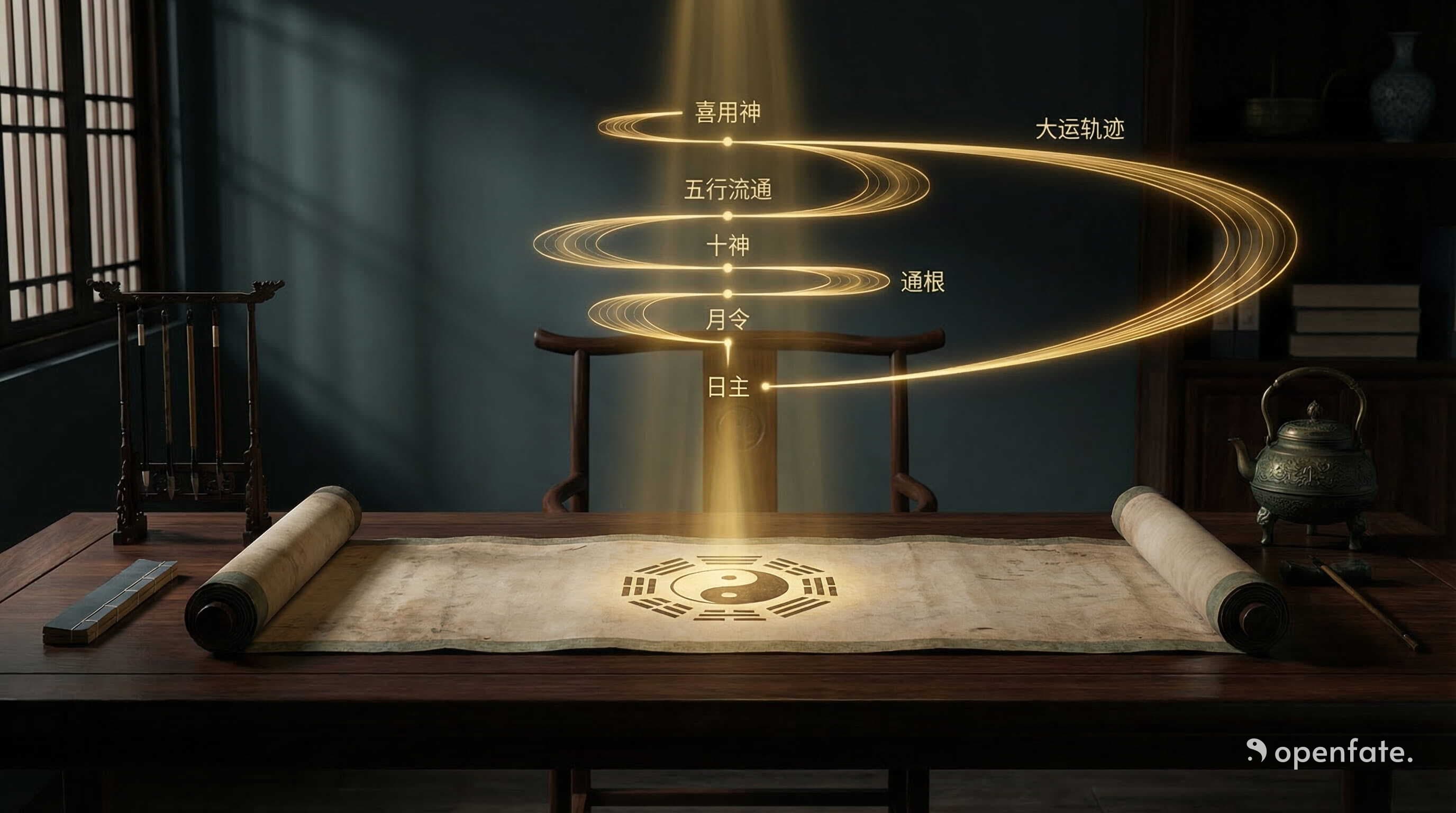
A traditional reading usually starts with the Day Master, uses the Month Branch to establish seasonal weighting, then reviews roots, Ten Gods, elemental flow, favorable elements, and Luck Pillars. This is a structured interpretive sequence, not an empirical method for predicting life events.
The first time you see a Bazi chart, the amount of data can be overwhelming. You see stems, branches, gods, and luck cycles but don't know where to start.
Randomly picking keywords like "Wealth" or "Peach Blossom" often leads to missing the main theme of the chart.
Reading a chart correctly requires a structured sequence: Core identity first, then environment, then support.
What Are You Actually Looking At?
A Bazi chart converts birth data into the traditional symbols of Four Pillars; it does not measure a physical energy distribution.
A reading organizes those symbols into a coherent interpretation of themes within the selected tradition.
Mistake #1: Starting With "What Am I Missing?"
Many beginners immediately ask "Am I missing Wood?" or "Do I need Fire?" While quantity matters, it is not the first step.
Bazi interpretation is not simple addition. Within the tradition, a missing element is not automatically favorable or something a person must physically add.
Step 1: The Day Master (The Core)
The Day Master is the stem of the day of birth and serves as the traditional reference point associated with the self.
It provides the coordinate for classifying supportive, controlling, and output relationships inside the chart—not for judging real people as helpful or harmful.
Step 2: The Month Branch (The Environment)
The Month Branch represents the season category used by the traditional method.
It changes how the system weights the Five Elements; that weighting does not determine a person's momentum or outcome.
Step 3: Roots and Support (The Foundation)
Check if the Day Master has "roots" in the Earthly Branches.
Roots change the traditional strength classification; they do not measure psychological resilience or long-term stability.
Step 4: Ten Gods Structure (The Operating Mode)
Identify which relationship pattern dominates your life framework.
Companions, Output, and Authority are relationship labels inside the system. They can frame reflection, but they do not establish a person's actual motives.
Step 5: Elemental Flow (System Smoothness)
How elements convert into one another is often more important than raw count.
Readers use smooth or blocked flow to describe the internal chart model, not to diagnose a person or guarantee a functional life pattern.
Step 6: Judge Chart Strength
Synthesize the previous five layers to judge if the Day Master is structurally strong or weak.
Strong and weak are internal chart classifications; they do not measure character, resilience, health, or real-world capacity.
Step 7: Identify Favorable Elements
Favorable elements are traditional balancing labels, not a medical or behavioral prescription.
They should be derived consistently from the chosen school after the earlier structural steps, with uncertainty stated.
Step 8: Luck Pillars and Annual Triggers
Traditional readers use Luck Pillars and annual cycles to discuss timing themes; they do not decide when an event will occur.
Auxiliary stars such as Nobleman or Peach Blossom remain optional symbolic details, not event evidence.
Summary of the Sequence
Read the framework first, then the timing. Read the skeleton first, then the labels. Follow these 8 steps for a stable reading.
Precision Starts With Data
Time, time zone, solar-term boundaries, location, and the selected True Solar Time convention can change the calculated chart.
Accurate inputs support an internally consistent chart; they do not validate the interpretive tradition or guarantee accurate life conclusions.
Deepen Your Bazi Knowledge
FAQ
Where do I start reading my chart?
Should I worry about missing elements?
Why does the month matter so much?
Ready to Read Your Chart Correctly?
Treat Bazi as a structured interpretive framework, not a guessing game. Start with an accurate chart and follow a consistent reading sequence.
 Read My Chart Step-by-Step
Disclaimer: Divination and metaphysical systems are traditional cultural frameworks, not modern science or professional advice. Use this content for reference and make decisions from real-world facts and qualified guidance.