
Key Lenormand meaning: card 33, combinations and contexts
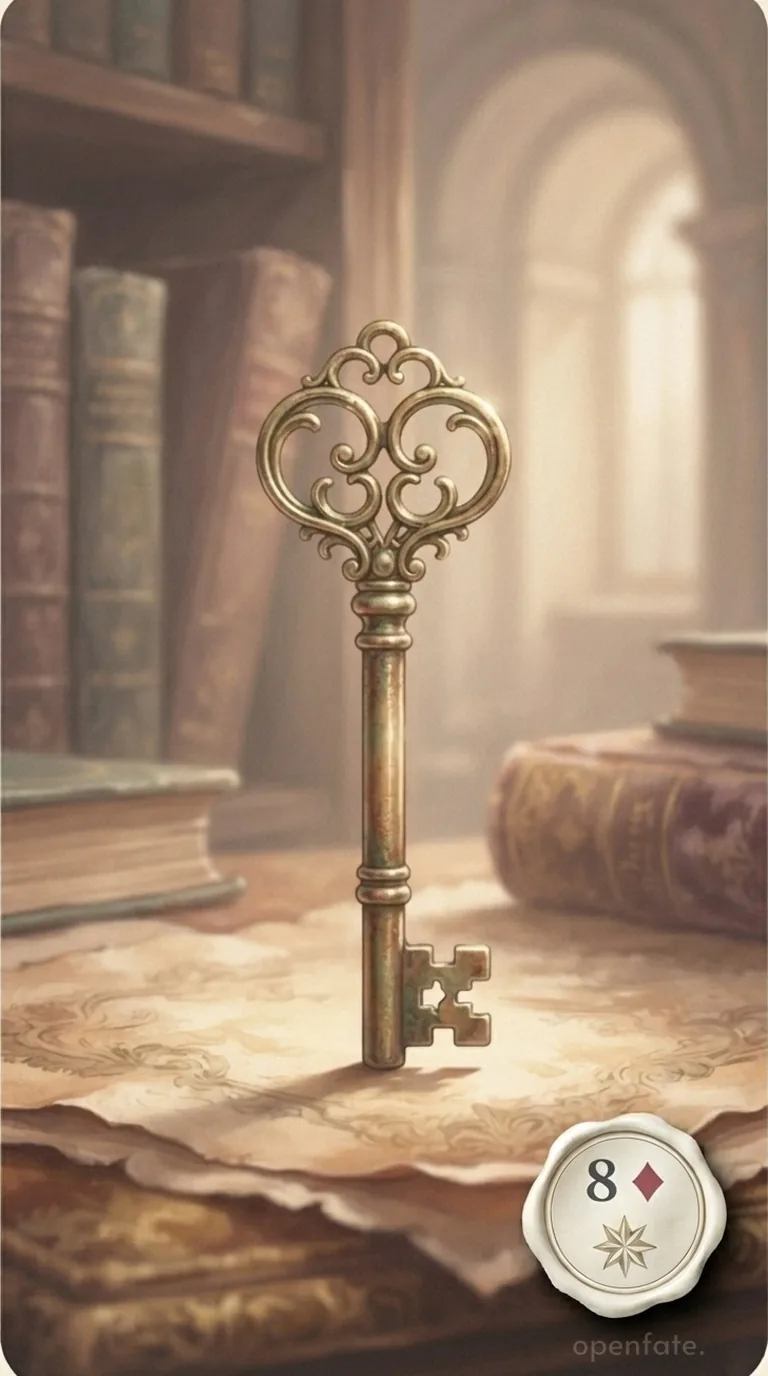
Card 33, Key: Access or a possible solution identifies the factor worth clarifying first because it may unlock progress.
Overview
Key is Lenormand card 33. Access or a possible solution identifies the factor worth clarifying first because it may unlock progress. Read it with the question, card order and neighboring cards rather than as an isolated verdict.
At a glance
- Card identity
- 33 · Key
- Playing-card inset
- 8 of Diamonds
- Working tone
- supportive
- Combination rule
- Keep the question, decision owner, time window, draw order and observable facts together.
Direct meaning
Access or a possible solution identifies the factor worth clarifying first because it may unlock progress.
Use Key as a concrete vocabulary item—access, solution, important opening, certainty, leverage—then let adjacent cards specify what changes, who is involved and under which condition.
- access
- solution
- important opening
- certainty
- leverage
Number, symbol and playing-card inset
33. Key · 8 of Diamonds · supportive.
Artwork can vary, so verify number 33 and the Key symbol before using directional details. Extra cards in a modern deck are not part of this 36-card reference unless declared.
Combination examples
Moon + Key: combine “reputation, recognition, feeling, visibility, emotional tide” with “access, solution, important opening, certainty, leverage” as one sentence, then keep only the reading supported by the question and full line.
Key + Fish: combine “access, solution, important opening, certainty, leverage” with “abundance, business, cash flow, resources, circulation” as one sentence, then keep only the reading supported by the question and full line.
Key + Clover: combine “access, solution, important opening, certainty, leverage” with “small luck, brief opening, lightness, short opportunity” as one sentence, then keep only the reading supported by the question and full line.
Key + House: combine “access, solution, important opening, certainty, leverage” with “home, family, stability, private life, foundation” as one sentence, then keep only the reading supported by the question and full line.
Key + Coffin: combine “access, solution, important opening, certainty, leverage” with “ending, closure, standstill, finished phase, pause” as one sentence, then keep only the reading supported by the question and full line.
Key + Scythe: combine “access, solution, important opening, certainty, leverage” with “sudden cut, decisive severing, harvest, abrupt action, risk” as one sentence, then keep only the reading supported by the question and full line.
Key + Fox: combine “access, solution, important opening, certainty, leverage” with “cunning, self-interest, work, watchfulness, verification” as one sentence, then keep only the reading supported by the question and full line.
Key + Garden: combine “access, solution, important opening, certainty, leverage” with “public, social life, gathering, network, audience” as one sentence, then keep only the reading supported by the question and full line.
Love, work and decision contexts
In a relationship question, Key keeps the focus on an observable version of its theme: Access or a possible solution identifies the factor worth clarifying first because it may unlock progress. Discuss actions, messages or agreements directly instead of using the card to declare another person’s hidden feelings.
At work, with money or in a decision, translate Key into a condition that can be checked against a document, deadline, cost or next action. The card can frame a question; it does not overrule those facts.
For a controlled Key practice set, compare it in turn with Moon, Fish, Clover, House, Coffin, Scythe, Fox, Garden. Keep Key in the same position each time, change only one partner, and note which wording changes because of that partner rather than because of hindsight.
Key is treated here as supportive for OpenFate’s declared working method. That label adjusts tone; it is not a probability or universal school rule.
- Moon
- Key
- Fish
Common mistakes and limits
Sources for Key document an object, chronology or named reading convention only within their stated scope. They do not establish predictive accuracy.
Do not use Key to diagnose health, prove hidden thoughts, bypass consent, guarantee an event, or replace legal, medical, financial or other professional evidence.
Sources and editorial basis
- British Museum · Das Spiel der Hofnung · 1896,0501.495British Museum · object 1896,0501.495 · no. 33 · 8 diamondsCollection record for a complete 36-card Game of Hope pack with running numbers, illustrated vignettes, French-suit miniatures, German equivalents and a four-page instruction leaflet. It documents the object, not predictive accuracy.
- British Museum · B. Dondorf Mlle Lenormand cards · 1896,0501.308British Museum · object 1896,0501.308 · no. 33 · 8 diamondsCollection record for a complete nineteenth-century B. Dondorf pack of 36 Mlle Lenormand playing cards. It supports later material deck identity and publisher history, not a universal meaning dictionary.
- OpenFate Lenormand reading and deterministic methodOpenFate · 36-card and spread-method reference · reviewed 2026-09-12 · no. 33 · 8 diamondsProduct reference for the 36-card identity, one-seed draws, three-card line, polarity-balanced yes/no and nine-card portrait. Editorial code inspection on 2026-09-12 is product evidence, not an independent traditional authority.